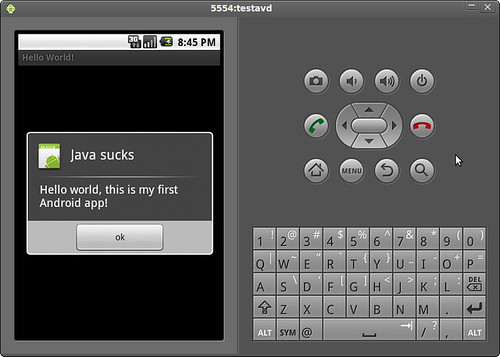
Yay, this is my first Android app! Java is really slow especially if you use Eclipse for development. I tried this on an amd64 machine with 2GB of RAM but this simple app still crawls to a halt. Anyway, I wish I can try this on a real phone.
/dev/sda does not contain a rootfsI might try tweaking the kernel configs some time to see if it would work. Meanwhile, I'll just install NetBSD.
/dev/sdb does not contain a rootfs
/dev/sdc does not contain a rootfs
/dev/sdd does not contain a rootfs
server.use-ipv6 = "enable"If you need to use SSL, simply use:
$SERVER["socket"] == "0.0.0.0:80" {
}
server.use-ipv6 = "enable"Tada! It works:
ssl.engine = "enable"
ssl.pemfile = "/var/etc/cert.pem"
$SERVER["socket"] == "0.0.0.0:443" {
ssl.engine = "enable"
ssl.pemfile = "/var/etc/cert.pem"
}
root@soulfury:/# sockstat | grep lighttpd
root     lighttpd   23974 4  tcp6   *:443                 *:*
root     lighttpd   23974 5  tcp4   *:443                 *:*
root@soulfury:/# sysctl -a | grep v6only
net.inet6.ip6.v6only: 1
AT
OK
AT+CMGF=1
OK
AT+CMGW="+639191234567"
> Hello world!
+CMGW: 1

OK
AT+CMSS=1
+CMSS: 20

OK

0,30  *   *   *   *   echo "Incoming cannon shots in 30 minutes." | say -v Vicki
29,59   *   *   *   *   echo "Incoming cannon shots in 1 minute." | say -v Vicki
before sending a new page request, the server checks the differences on what the client already has, and what its going to sent. the difference is then compressed and sent, browser on the client patches it. this should provide amazing improvement.
My idea is to make a giant web where the internet connection is splitted between the people connected so there is no connection wasted, think for example, when somebody with 10 mb/s turns off the pc nobody can use that speed, maybe you can make it :)
Governments should aim to provide affordable broadband access for all citizens, in the same way they provide access to affordable water, electricity or shelter.
The government needs to subsidize the various brodband access methods out there. Things like Brodband over Power lines, and low orbit satellites. We've spent 7.4 trillion, one would think there is some money in there to fund this stuff.
2 ways to make the web faster, 1st one is stopping illegal contents, spams & peer2peer streams, to access & saturate large % of ISPs bandwidth; the 2nd one is replacing the customer's outdated PSTN cables by optic fiber, but how will pay THE BILL ?
Use bandwidth effectively by removing the limits and allocating it to who use them the most,...instead of giving high bandwidth for a person who uses internet just to check an email, give it to someone who runs a webserver...
most websites are templated on the serverside, and for most websites every page you view means about 20% of data transfer is the template. the template should only load once, and should be done in browsers.
P2P browser: Standard browsing is exclusively client/server. Imagine instead that every browser is a P2P app and reports webpage data it downloads to "tracking servers" so when someone else wants the same page they get it from several peers instead
Extend HTML mark-up with new elements. The code will be more complicated because of more elements, but much shorter. Same with CSS - extend number of properties to resolve different tasks by one style property. Reduce size of properties names for CSS
Apache has modules like mod_perl, mod_php and other that allow you to extend the functionality of the browser. While Firefox 'plugins' do that for the frontend, why not make modules for the 'backend' of the browser that enable you to send PHP or Perl
Come up with rules which can't be explained by different ways. Like padding in IE and FF - now to make page with same look in all popular browsers you should add more code and CSS which increase size of page and take more time...
Developers need to comeup with a way to use the already existing information through browoser. Say if it is the same IP packets receiving from the past try to use it and construct the patterns. Avoid duplicate bits to receive. This helps in bandwidth
Many headers that are being sent as part of every HTTP req. and resp, though all HTTP headers are optional. Web servers have to rethink on file naming and their url references. Smaller data to be transported means faster transport.
Why don't we have an alternative to HTML? I mean open source, anyone can commit changes to the source, and a group oversees which changes are actually put in place. HTML5 will not be released till 2022, and that's when you realize it's ridiculous.
w3c should regulate the release of browsers. if a browser doesn't pass all the tests for a standard, it should be allowed to call itself a "browser" . because of browsers not following standards, we forcefully hv to implant hacks, and make web slower
simoncpu-dev:~# apt-get moo
         (__)
         (oo)
   /------\/
  / |    ||
 *  /\---/\
    ~~   ~~
...."Have you mooed today?"...
simoncpu-dev:~# aptitude moo
There are no Easter Eggs in this program.
simoncpu-dev:~# aptitude -v moo
There really are no Easter Eggs in this program.
simoncpu-dev:~# aptitude -vv moo
Didn't I already tell you that there are no Easter Eggs in this program?
simoncpu-dev:~# aptitude -vvv moo
Stop it!
simoncpu-dev:~# aptitude -vvvv moo
Okay, okay, if I give you an Easter Egg, will you go away?
simoncpu-dev:~# aptitude -vvvvv moo
All right, you win.

                               /----\
                       -------/      \
                      /               \
                     /                |
   -----------------/                  --------\
   ----------------------------------------------
simoncpu-dev:~# aptitude -vvvvvv moo
What is it?  It's an elephant being eaten by a snake, of course.


You can move or copy it anywhere you want. What's important is that it's accessible outside the original directory because Mac OS X doesn't treat the package as a navigable directory.
simoncpu@soulfury:~/Documents/Virtual Machines$ ln -h "Debian Linux.vmwarevm/Debian Linux.vmdk"
